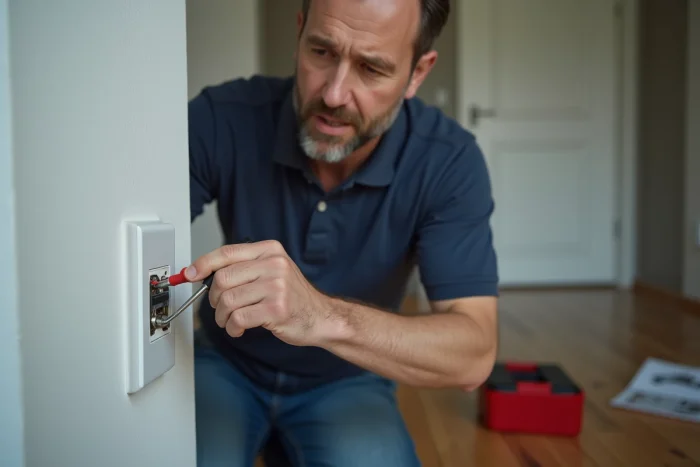
Safety is non-negotiable, never. Detaching the wires from a Schneider socket is not trivial: the slightest misstep can lead to material damage or worse. There’s no question of yanking a cable at random: a small lever may be lurking, ready to stop your momentum. A clumsy movement, the wrong tool, and there goes the mechanism broken or the copper exposed.
Sometimes we let our attention slip on these everyday actions. However, treating routine lightly is taking the gamble of accidents that electricians could recount, as long as an insurance bill. A faulty tool or poorly neutralized current and the consequences are swift.
What you need to know before working on a Schneider socket
With a Schneider socket, improvisation does not exist. Removing a wire requires method and meticulous attention to the NF C 15-100 standard. Mureva Styl, Odace, Alréa… each reference has its specifics. Respecting the rules, being vigilant about the equipment, but above all, being rigorous with every action is essential.
Everything starts with the main circuit breaker: cutting off the power is not just about pressing a button or flipping a switch. A voltage tester becomes your best ally to verify the complete absence of current. The classic colors? Blue for neutral, red or brown for phase, yellow-green for ground: these are markers that never deceive the trained eye.
Some Schneider models have additional devices: child safety, surge protection, locking options. It’s best to have identified them to avoid forcing a connector or breaking a part when removing the wires. Moreover, a dedicated guide like removing the wires from a Schneider socket details each action step by step to limit distractions and mistakes.
Three checkpoints set the stage before starting:
- Examine the compliance of all connections with the NF C 15-100 standard and mentally prepare for the next steps;
- Identify the precise type of Schneider socket, its modules or options, to have the right tools at hand;
- Check that the equipment is complete and in good condition: insulating gloves, electrician’s screwdriver, reliable tester, nothing should be missing from the toolkit.
Rushing, skipping a step, or thinking “it will be fine” is inviting an accident. Electricity rarely forgives negligence.
How to safely remove wires from a Schneider socket?
Working on a Schneider socket requires method. Start by cutting the power at the main circuit breaker and systematically confirm the absence of voltage with the tester. Simply turning off the light would be taking an unnecessary risk: an installation can sometimes hold unpleasant surprises.
Preparing is already acting. Plan for the appropriate insulated screwdriver, put on gloves, have a wire stripper and connectors ready in case you need to temporarily protect the conductors. Once the faceplate is removed, the next steps require precision:
- Unscrew all terminals, without forcing, to avoid weakening the interior of the mechanism;
- Remove the wires one by one, remembering their assignment; you can draw a diagram or take a photo, this reflex saves from doubt during reassembly;
- Install a connector on each freed wire and close the box with a cover or plate to prevent any accidental contact.
At the slightest unusual resistance or an uncertain configuration, never insist: it’s better to call a professional. Sometimes, a trained eye and sure hand turn a puzzle into a simple formality, without the risk of damaging everything or putting oneself in danger.

Going further: best practices and resources for handling electricity safely
Adopting the reflex of cutting off the power is acting smartly. The NF C 15-100 standard is not just a rule on paper: it shapes every detail, guiding the approach to electricity, from the simplest socket change to the complete wiring of a room.
Some habits are worth more than warnings: no bare wire left exposed, no unsuitable tools, never a live part. These are the first basics for ensuring that every intervention goes smoothly.
To cultivate caution, three reflexes to embed in your routine:
- Know the precise model of Schneider socket before opening it, check for the presence of any special modules to anticipate the procedure;
- Before handling, take a picture or note the wiring diagram; this small gesture avoids many knots during reassembly;
- Doubting is already protecting: if you spot a damaged wire, a deformed box, or any suspicious sign, quickly involve a professional.
No home is immune to an incident, even trivial: it only takes one overlooked detail, and the circuit trips or the current stops. Getting into the habit of checking your residual current device and keeping an eye on the connections ensures lasting peace of mind. With a dose of rigor and experience, what seemed technical becomes reflexive, for years of DIY without unpleasant surprises or unjustified fears.