
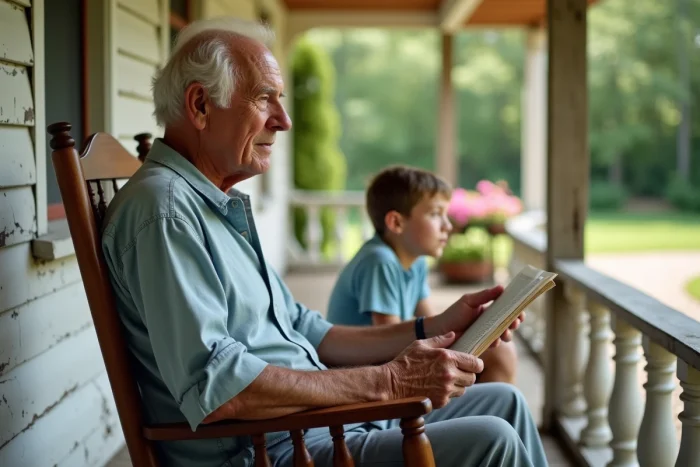
One weekday evening, a parent opens an album in front of a four-year-old child. After three sentences, the child loses interest. The problem lies neither with the book nor the child, but with the way the story is delivered. Telling stories for both young and old relies on specific mechanisms that silent reading does not engage: vocal rhythm, pauses, prompts. Mastering these mechanisms changes the quality of listening as well as the pleasure of the storyteller.
Voice and Rhythm: The Two Concrete Levers of the Storyteller
The role of the body in oral narration is often overlooked. Before choosing a tale or an album, a technical parameter must be set: the pace of speech influences attention. Speaking too quickly drowns out mental images. Speaking too slowly causes the adults present to lose interest.
The most effective technique for capturing a mixed audience (children and adults in the same room) is to vary the volume rather than the vocabulary. Lowering the voice at a moment of danger in the story compels active listening. Raising the volume during a comedic line re-energizes the group.
Practical resources on oral narration and age-appropriate tales can be found at https://racontemoi.fr/, with content designed to support both parents and facilitators.
A often underestimated point: silences are part of the story. Pausing for two seconds before a twist creates suspense that even the youngest can perceive. Professional storytellers work on these silences as much as their text.
Adapting a Tale by Age Without Distorting It
It is often said that stories need to be simplified for younger audiences. In practice, simplifying does not mean cutting. It means restructuring episodes while keeping the complete narrative arc (initial situation, obstacle, resolution).
Tales for Children Under Five
Children of this age better follow repetitive structures: a character encounters three similar obstacles before succeeding. Journey tales operate on this principle. Each repetition reassures and allows the child to anticipate, which strengthens their engagement.
Shorten descriptions, but keep dialogues. A three-year-old does not remember that a forest is dark and deep. However, they will remember that the wolf said “I will eat you” in a big voice.
Narration for Older Children and Adults
Adults react to the same narrative triggers as children, provided that ambiguity is added. A classic tale told to an adult audience gains power when a moral doubt is left hanging, when the ending is not entirely reassuring.
Feedback varies on this point: some adult audiences prefer short and punchy tales, while others enjoy longer narratives with digressions. Adjustments are made in real-time by observing the group’s reactions.
Creating Your Own Stories: Tools and Ground Method
Telling stories is not limited to reading an existing book. More and more parents and facilitators are crafting their own narratives, sometimes with the help of digital tools. Platforms like Jenova.ai allow for the generation of illustrated children’s books, featuring recurring characters and text suitable for reading aloud.
This approach transforms the role of the storyteller. We move from recitation to co-creation: the adult becomes the story director rather than just a reader. The child can request a change of character or a different ending, and the narrative adapts.
- Define a main character that the child knows (a familiar animal, an everyday object) to anchor the story in their experience
- Build the obstacle around an identifiable emotion (fear, frustration, curiosity) rather than around a spectacular event
- Plan two possible endings: one reassuring, one open, and let the audience choose
Conversational applications like Storyteller also offer interactive narration where the child directs the unfolding of the tale in real-time. This hybrid format between reading and play particularly appeals to children accustomed to screens.

The Storyteller as a Profession: Training and Skills to Acquire
Telling stories in a professional setting (libraries, schools, festivals) is not improvised. The Maison des arts de la parole documents the professionalization of the storyteller’s job, with training focused on the oral repertoire, transmission techniques, and the work of public relations.
A professional storyteller builds a repertoire like a musician. Each story is rehearsed, adjusted, and refined in front of different audiences before being considered mastered. This preparation work distinguishes professional narration from improvised reading.
- Knowledge of the traditional repertoire (tales by Perrault, Grimm, African and Asian oral traditions) to draw from a common fund
- Body techniques: breath management, posture, space occupation, eye contact distributed among the audience
- Ability to adapt in real-time: modifying length, register, or rhythm according to the audience’s reaction
- Specific work on narrative memory (retaining the storyline, not the text word-for-word) to keep the speech alive
This structuring of the profession opens up concrete opportunities in animation, early childhood, and cultural mediation. Training typically combines practical internships and individual support on the repertoire.
Telling a story remains as much a physical act as an intellectual one. Whether addressing a three-year-old or a group of adults, the fundamentals do not change: a steady voice, a mastered rhythm, and embraced silences. Digital tools enrich the palette without replacing this foundation. The best storyteller is the one who observes their audience and adjusts each sentence to what they perceive in the room.