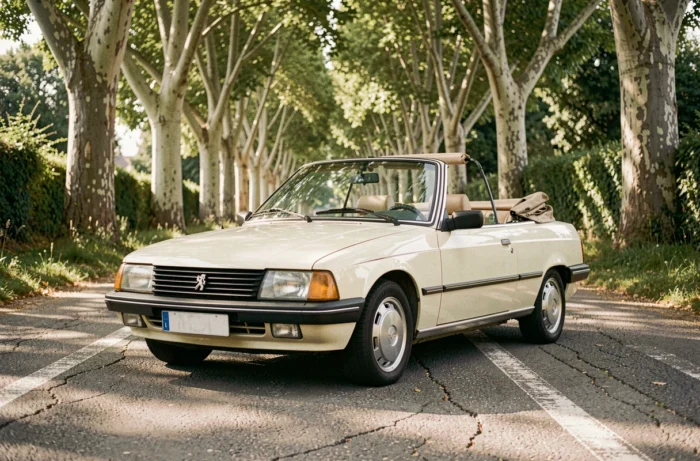
The Peugeot 305 convertible does not exist in the official catalog of the brand. Peugeot has never marketed a convertible version of its sedan produced from 1977 to 1990. The examples that circulate today result from artisanal transformations, carried out by independent coachbuilders or individuals. This particularity radically changes the perspective for anyone considering acquiring one: the retro charm comes with a technical and administrative examination that is much more demanding than for a production convertible.
Peugeot 305 convertible and collector’s registration: what the transformation changes
The status of a collector vehicle, issued via the FFVE, is based on a principle of conformity to the original. The vehicle must be at least 30 years old, its type must no longer be produced, and its technical characteristics must correspond to those of the period model. A convertible transformation involves a structural modification of the body, which may compromise eligibility.
This point deserves to be established before any aesthetic or mechanical considerations. A buyer enchanted by the lines of a convertible 305 must check if the transformation has been documented, approved, and if the vehicle maintains coherence with the original type approval.
| Criterion | Original 305 sedan | 305 convertible (artisanal transformation) |
|---|---|---|
| Eligibility for collector’s registration | Yes, if compliant with the original | Compromised by body modification |
| Technical inspection | Every 5 years (collector status) | Standard regime if status refused |
| Circulation in ZFE | Possible according to applicable framework (collector status) | Uncertain without collector’s registration |
| Traceability of modifications | Not applicable | Transformation file required |
The table above summarizes the administrative gap between the two configurations. Without collector’s registration, the 305 convertible loses several practical advantages, including the reduced frequency of technical inspections and the ability to circulate in certain low-emission zones.
For those who wish to discover the Peugeot 305 convertible from all angles, the question of administrative status directly conditions daily use.
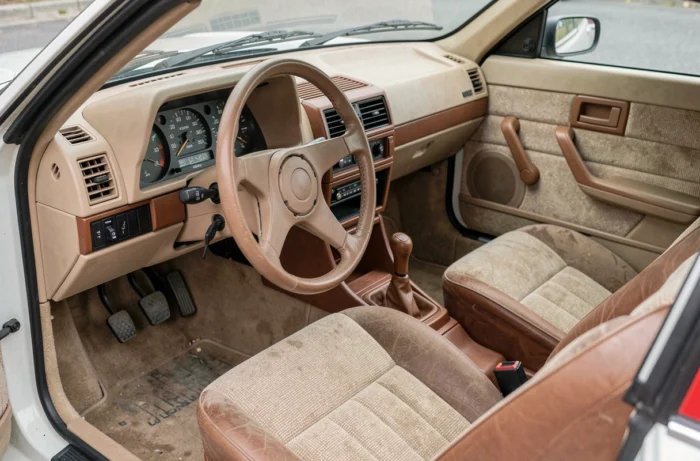
Structural rigidity of a convertible 305: an underestimated technical point
Removing the roof of a three-box sedan is not just about cutting metal. The 305 was designed with a roof that contributes to the overall rigidity. Once removed, the body loses part of its torsional resistance.
Coachbuilders who carried out these transformations in the 1980s or 1990s have, in some cases, added reinforcements to the chassis, support bars under the floor, or hidden roll bars. The quality of these interventions varies significantly from one example to another.
- Check for the presence of structural reinforcements under the floor and in the windshield pillars, as their absence generates vibrations and visible deformations at the doors.
- Examine the weld points added during the transformation: irregular or corroded welds indicate amateur work that affects road handling.
- Check the alignment of the openings (doors, hood, trunk), a misalignment revealing a deformation of the body due to the loss of rigidity.
A poorly reinforced 305 convertible deforms over time. The doors close less well, creaking sounds appear, and road handling deteriorates. This structural diagnosis constitutes the first filter of evaluation before any purchase.
Peugeot 305 in ZFE: collector status as an argument for urban circulation
Low-emission zones are multiplying in France. A 305 from the late 1970s or 1980s obviously does not have a favorable Crit’Air sticker. Without collector status, circulation in ZFE becomes problematic, even impossible according to the local regulations in force.
The status of a collector vehicle offers a possibility of circulation in ZFE according to the applicable framework. This is a concrete argument for owners who wish to use their 305 beyond Sunday gatherings.
However, this status remains conditional on the vehicle’s compliance. A 305 convertible whose transformation has not been homologated properly finds itself in a deadlock: too old for Crit’Air criteria, too modified for collector status. The buyer must demand a complete transformation file before signing.
What documents to ask the seller
The registration certificate must mention the type of body. If the mention “convertible” or “cabriolet” is not included, the transformation has probably not been declared. A single vehicle approval report (RTI) issued by the DREAL certifies compliance after modification. Without this document, the administrative situation remains fragile.

Value and rarity of the Peugeot 305 convertible in the collector car market
The 305 remains a car that is not very visible in collections. Competitors in the segment (Renault 18, Citroën GSA) share this relative anonymity. The convertible version, because it was never produced in series, exists in extremely limited quantities.
This rarity works both ways. It makes the model attractive to enthusiasts of atypical pieces, but it also complicates resale: the pool of potential buyers remains narrow. The body parts specific to the transformation (hood, reinforcements, folding mechanism) are not found in the usual Peugeot spare parts networks.
The standard 305 sedan, on the other hand, still benefits from a reasonably stocked network of mechanical parts. Engines, running gear, braking elements are shared with other models from the Peugeot range of the time. The mechanics remain accessible, the convertible body does not.
Maintenance cost: affordable mechanics, custom bodywork
The routine maintenance of a 305 does not pose any particular difficulties. The gasoline and diesel engines of the time are simple and well-documented. The additional cost specific to the convertible version focuses on the hood (replacement, sealing) and any structural repairs related to the transformation.
A savvy buyer thus distinguishes between two budgets: that of Peugeot mechanics, predictable, and that of artisanal bodywork, variable depending on the initial quality of the work.
The Peugeot 305 convertible remains a niche object, halfway between a passionate project and an atypical collector vehicle. Its appeal lies in a real rarity and a line that the roof cut makes unique. Acquiring it without checking the transformation file, administrative status, and structural rigidity exposes one to disappointments that far exceed the mechanical budget.