
After 60, screening is not limited to a standardized list of biological tests. Individual risk stratification determines the choice of exams, their frequency, and their interpretation. We recommend distinguishing systematic assessments, offered to the entire population, from targeted explorations that are justified only by a specific clinical profile.
My Prevention Assessment between 60 and 65: a device still underused
The My Prevention Assessment program, implemented by the Ministry of Health, specifically targets the 60-65 age group. The consultation lasts 30 to 45 minutes, with no upfront costs, and covers a much broader spectrum than a standard blood test.
A preliminary self-questionnaire addresses physical activity, mental health, risk behaviors, living environment, and difficulties that may require management. This behavioral aspect is the real innovation: it helps identify vulnerabilities that neither blood sugar nor an electrocardiogram can reveal.
The healthcare professional then establishes a personalized prevention plan. They check vaccination status, guide towards organized screenings, and adjust recommendations based on medical history. We observe that this appointment remains unknown, even though it constitutes the most structured entry point for organizing coherent follow-up. You will find medical information on Medic Com detailing the prevention pathway after 60.
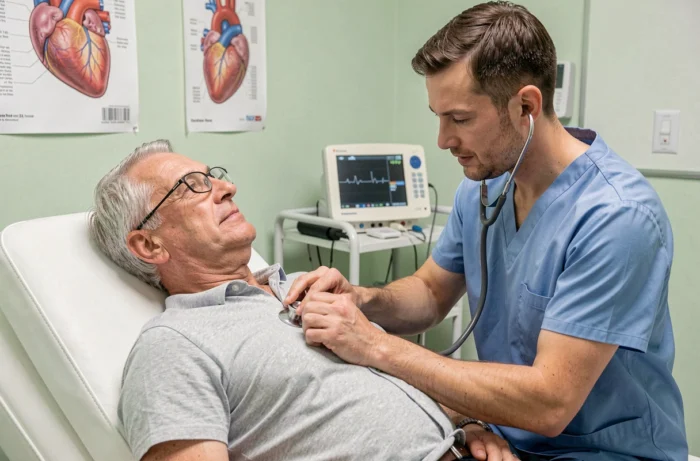
Cardiovascular Assessment after 60: beyond simple blood pressure control
Measuring blood pressure remains the basic gesture, but it is not sufficient to assess overall cardiovascular risk. We recommend a complete lipid profile coupled with a fasting blood sugar, performed at least every three years for a patient without known risk factors.
A resting electrocardiogram detects rhythm or conduction abnormalities that the patient may not feel. In seniors with a heart murmur, exertional dyspnea, or family history, transthoracic echocardiography provides functional data on the valves and ejection fraction.
A technical point often overlooked: the assessment of arterial stiffness. The ankle-brachial index helps detect silent peripheral artery disease, which is common in this age group. This non-invasive examination is performed in the office of the primary care physician or cardiologist.
Frequency and clinical judgment
A diabetic, smoker, or hypertensive patient does not follow the same schedule as a senior without a history. The primary care physician remains the pivot of risk stratification, adapting the frequency of assessments to each patient’s profile rather than applying a uniform scheme.
Cancer screenings after 60: what the organized program covers and what it does not
The organized screening for colorectal cancer relies on the fecal immunological test, offered every two years between ages 50 and 74. Its sensitivity for detecting cancer is high, but it decreases for advanced adenomas. In case of a positive result or first-degree family history, colonoscopy remains the reference examination.
For women, bilateral mammography as part of the national program is offered every two years until age 74. After this age, screening is no longer systematic, which does not mean it becomes unnecessary: the decision to continue depends on estimated life expectancy and comorbidities.
- Prostate cancer: PSA testing is not recommended for systematic screening by the High Authority of Health. It is discussed on a case-by-case basis, after clear information about the risks of overdiagnosis and overtreatment.
- Lung cancer: no organized screening program exists in France to date. A low-dose chest CT scan may be considered for heavy smokers or former smokers, upon specialist advice.
- Skin cancer: an annual dermatological examination is relevant for light phototypes, patients with a high number of nevi, or those with a history of severe sunburns.
Senior vaccination: recent developments to know
The vaccination schedule after 60 is not limited to the dTP (diphtheria-tetanus-poliomyelitis) booster every ten years. The annual flu vaccination remains recommended, fully covered by Health Insurance for people aged 65 and older.
Regarding pneumococcus, the strategy has recently evolved. The High Authority of Health now recommends preferential use of the CAPVAXIVE vaccine for at-risk adults and those aged 65 and older. This change should be verified during the Prevention Assessment to update vaccination status.
Shingles poses an increasing risk with age. The recombinant vaccine (Shingrix) is recommended starting at age 65, including for immunocompromised patients. It is administered in two doses spaced two months apart.

Fall prevention and sensory assessment: examinations too often postponed
The High Authority of Health has published specific recommendations on fall prevention for elderly individuals living at home. The evaluation is based on several complementary axes:
- Ophthalmological check-up with measurement of visual acuity, visual field, and screening for glaucoma and age-related macular degeneration (AMD). An examination every one to two years is relevant.
- Tonal and vocal audiogram to detect presbycusis, for which early management through hearing aids reduces the risk of cognitive decline.
- Assessment of balance and gait (Timed Up and Go test, single-leg support), feasible in a general medicine consultation.
- Bone density measurement (DXA) recommended for postmenopausal women with fracture risk factors, and to be discussed for men over 70 with identified factors.
An uncorrected sensory deficit multiplies the risk of falls and social isolation. The combination of visual, auditory, and postural assessments forms a prevention triptych often more cost-effective than expensive imaging prescribed without clear indication.
Prevention after 60 becomes more effective when it relies on a comprehensive evaluation rather than isolated examinations. The My Prevention Assessment program offers a structured framework, but it is the ongoing relationship with the primary care physician that allows for the adaptation of the care pathway to the clinical realities of each patient.