
A freshly painted wall that gives off a persistent odor three weeks after the work, a bathroom where condensation never dries despite heating, a living room where one coughs every morning for no apparent reason: these situations all point to an indoor air quality problem.
Adopting a healthy home is not just about opening the windows. It is a set of technical choices, from ventilation to materials, that determine whether we breathe properly at home.
Radon and invisible pollutants: what the nose does not detect
We often think of mold or paint odors, but some household pollutants go completely unnoticed. Radon, a natural radioactive gas that rises from the ground, accumulates in ground-floor homes, basements, and geologically exposed areas (granite massifs, certain volcanic regions). According to ADEME, this gas poses an underestimated health risk in French housing.
Volatile organic compounds (VOCs) present a comparable problem. They come from paints, glues, particle board furniture, and even some household products. Unlike humidity, we cannot see them, and their effects on health manifest over the long term: respiratory irritations, chronic headaches, unexplained fatigue.
To limit exposure, we check the emission labeling on each product before purchase. A+ rated products emit very low VOCs. When renovating, it is better to choose low-emission paints and coatings rather than masking a degraded wall with a “cosmetic” covering that adds a layer of pollutants. Additionally, noximaison.fr’s advice details the criteria to monitor room by room to reduce these invisible sources of indoor pollution.
Mechanical ventilation in a home: beyond daily airing
Opening the windows for half an hour a day remains a good reflex, but it is not enough to guarantee healthy indoor air, especially in newer or well-insulated homes. The more airtight a building is, the more it needs a continuous air renewal system.
Single-flow or double-flow ventilation
Single-flow ventilation extracts stale air from humid rooms (kitchen, bathroom, toilet) and allows fresh air to enter through facade openings. This is the most common system. Double-flow ventilation, on the other hand, recovers heat from the outgoing air to preheat the incoming air. It is more expensive to install, but reduces heat loss associated with air renewal.
Feedback varies on this point: in an old poorly insulated home, a double-flow system may not yield the expected results if the building envelope is not treated in parallel. It is more beneficial to combine insulation and appropriate ventilation than to invest in just one aspect.
Maintenance of vents and ducts
A dirty ventilation system loses efficiency quickly. We clean the extraction vents and air inlets at least twice a year, vacuuming dust and wiping with a damp cloth. The filters of a double-flow system are replaced according to the manufacturer’s recommendations, usually every six months. A blocked duct no longer renews the air: it causes stagnation.
- Check that the extraction vents are working properly by bringing a sheet of paper close (it should stay pressed against the vent)
- Never block the air inlets on the facade, even in winter, as this can promote condensation and mold
- Have the entire network checked by a professional every three to five years, especially if the home was built before 2000
Eco-friendly materials and renovation: choosing wisely
When undertaking renovation work, the choice of materials directly impacts air quality for the years that follow. A lime-based plaster, for example, naturally regulates humidity and does not emit VOCs. A bio-sourced insulation material (wood fiber, cellulose wadding, hemp) offers good thermal performance while limiting harmful emissions.
Choosing low-emission materials does not necessarily cost more. For paints, the price difference between an A+ rated can and a low-end can is often marginal. For insulation, bio-sourced solutions can sometimes be the same price as fiberglass once energy renovation aids are deducted.
A common pitfall: renovating insulation without adapting ventilation. When the airtightness of a home is increased, the humidity produced by cooking, showering, and the occupants’ breathing has no natural escape. Without effective ventilation, new insulation can worsen humidity problems instead of solving them. Insulation and ventilation should be considered together, not one after the other.

Daily actions to maintain healthy indoor air
Beyond renovations, certain daily habits make a real difference in the air quality of your home.
In the kitchen, we use the extractor hood every time we cook, not just when it’s smoking. Fine particles generated by gas cooking or high-temperature cooking disperse throughout the home. In the bathroom, we wipe down the shower walls after use and leave the door open to speed up drying.
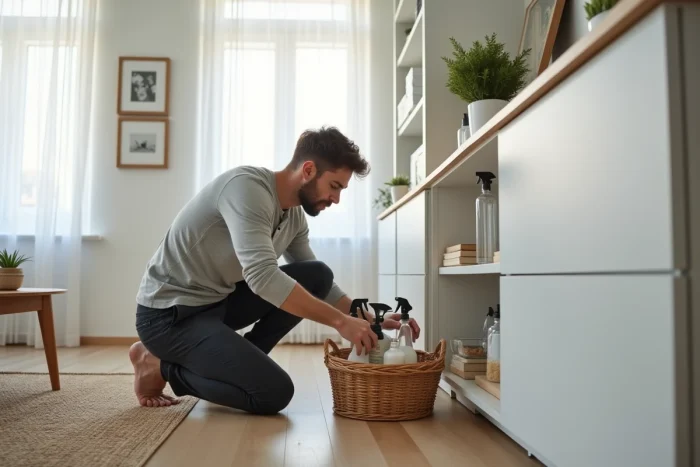
- Replace industrial cleaning products with simple alternatives: white vinegar, baking soda, black soap. They clean effectively without releasing chemical pollutants into the air
- Avoid scented candles and incense, which emit fine particles and benzene in significant amounts
- Wash sheets and duvet covers weekly at high temperatures to limit dust mites, the primary source of indoor allergens
- Dust surfaces with a damp cloth rather than a feather duster, which puts particles back into the air
A healthy home relies on the combination of ventilation, materials, and maintenance. None of these three pillars compensates for the absence of the other two.
Starting with a diagnosis of the existing ventilation and a check of ambient humidity allows for the identification of priority areas before incurring expenses. The most cost-effective approach is often to address first what we cannot see: the air we breathe all night.