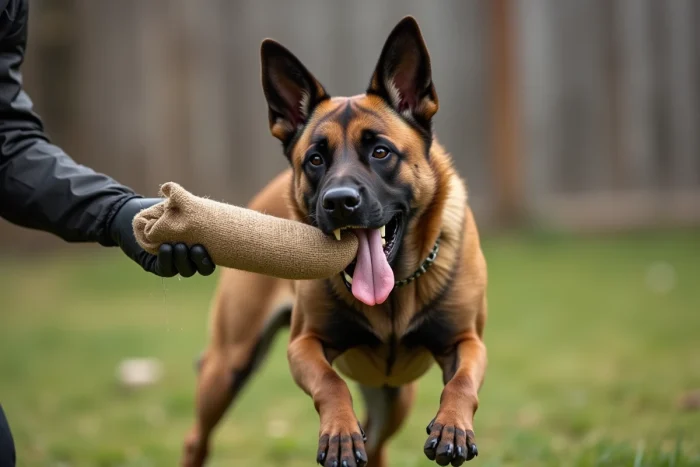
The pressure exerted by the jaw of the Malinois is the subject of many claims on the internet, with figures that vary significantly from one source to another. Measuring a dog’s bite force requires a precise protocol, an appropriate sensor, and reproducible conditions. The Malinois, although ubiquitous in working units, has not been the subject of a published scientific study in a peer-reviewed journal specifically measuring its jaw strength.
Dog Bite Measurement Protocols: Why the Numbers Vary So Much
The published bite forces for working dogs directly depend on the device used. Hand-held dynamometers, sensors integrated into a bite sleeve, instrumented platforms: each method produces different results for the same animal.
Recent guidelines in animal biomechanics, particularly the work of Gignac and Erickson, recommend distinguishing between in vivo measurements (a living dog biting a sensor) and morphometric estimates (modeling based on skull shape). The latter systematically overestimate the actual force, as they calculate a theoretical potential without considering the dog’s motivation or the biting angle.
A direct consequence: comparing the jaw strength of the Malinois in kg with that of a Rottweiler or a German Shepherd only makes sense if both breeds have been tested with the same device, under the same conditions. This is almost never the case in comparative tables found online.
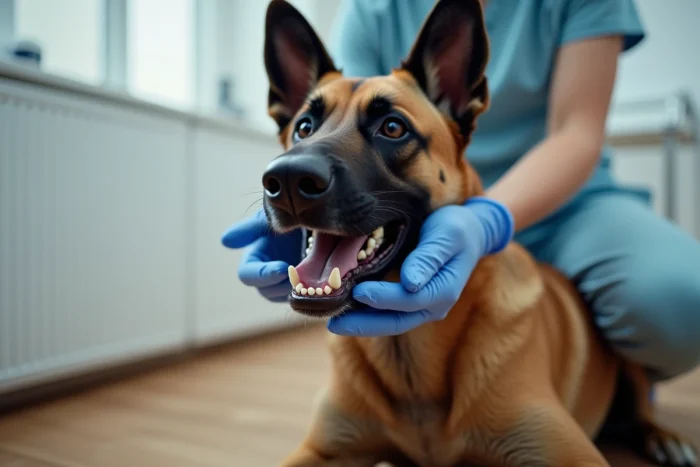
Jaw Pressure of the Malinois Compared to Other Working Breeds
The figures commonly attributed to the Malinois hover around 195 PSI, sometimes expressed in kg/cm². These values circulate widely, but no scientific publication with a validated protocol confirms them for this specific breed. The only robust experimental data on canine bite force comes from studies on other breeds, such as the work of Ellis et al. (2009) on Rottweilers, German Shepherds, and Pitbulls.
| Breed | Commonly Cited Bite Force (PSI) | Published Scientific Data |
|---|---|---|
| Kangal | 743 | No peer-reviewed study |
| Rottweiler | 328 | Ellis et al. study, 2009 |
| German Shepherd | 238 | Ellis et al. study, 2009 |
| Malinois | 195 | No specific published study |
| Pitbull | 235 | Ellis et al. study, 2009 |
This table highlights a major gap: the Malinois is absent from scientific measurement protocols. The values attributed to it come from non-standardized estimates or informal tests.
PSI and kg/cm²: Two Units, Same Confusion
PSI (pounds per square inch) is the most common unit in English-speaking comparisons. In France, some sites convert to kg/cm² without specifying the original measurement method. This double conversion, often approximate, adds a layer of imprecision to already fragile data.
Malinois Morphology and Implications for Bite Power
The Malinois is a medium-sized dog, lighter than the German Shepherd or Rottweiler. Its head is proportionally finer, with an elongated muzzle and less bulky masseter muscles than those of molossoid breeds.
In biomechanics, cranial muscle mass directly influences closing force. A wide skull with spaced zygomatic arches offers more surface area for jaw muscle insertion, resulting in higher bite pressure. The Malinois, with its shepherd morphology, does not have this structural advantage.
What distinguishes the Malinois in bite work is not so much the raw pressure but the combination of several factors:
- A very high bite speed, which partially compensates for a lower pressure than that of molossers
- An intense prey drive that maintains pressure over time, where other breeds release it more quickly
- An agility and responsiveness that allow it to quickly reposition its grip during a bite exercise
Training the Malinois and Managing Jaw Power
A dog’s jaw strength does not predict its behavior. The report from the American Veterinary Medical Association (AVMA) on dog bites, updated in 2024, emphasizes that breed alone is not a reliable indicator of bite risk. The determining factors are the dog’s socialization, training, and environment.
For Malinois owners, managing the jaw begins at a young age. Bite inhibition, this learned reflex that prompts the dog to control the pressure exerted by its jaws, is primarily acquired between the third and sixteenth week of life.
Early Socialization and Bite Control
A properly socialized Malinois learns to modulate its jaw pressure in contact with its peers, children, and other animals. This self-regulation ability is more decisive than raw power in assessing the actual risk associated with a working dog’s bite.
- Exposing the puppy to varied contexts (noises, people, other animals) before four months
- Working on bite inhibition through play, interrupting interaction as soon as the pressure becomes excessive
- Maintaining regular mental stimulation in adulthood to channel the breed’s natural drive
A Malinois whose training and socialization have been neglected poses a higher risk, not because its jaw is more powerful than that of a Rottweiler, but because its behavioral intensity amplifies the consequences of a lack of control.
Bite pressure figures attract attention, but they obscure the information that is truly useful for an owner. The relevant question is not how many PSI a Malinois can exert, but to what extent its training allows it to never use them.